
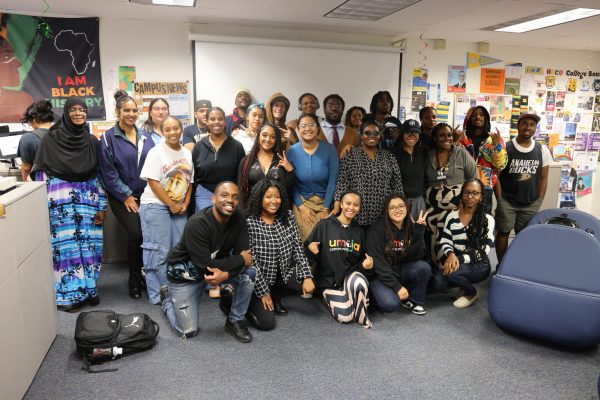
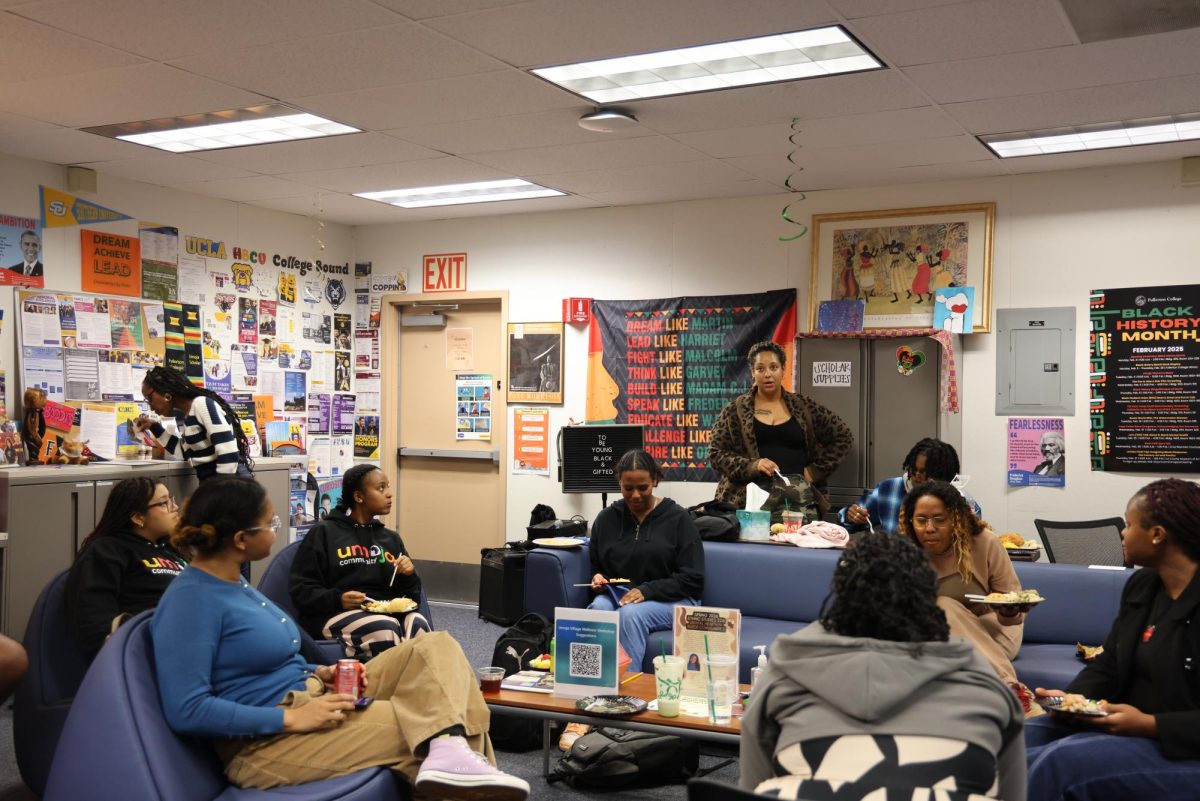
Warmth settled into the room at the Fullerton College Umoja Friendsgiving dinner on Monday. First-year students, returning students, student-athletes and community members gathered around the communal lounge, creating the kind of family environment many had been missing.
For Black students navigating a predominantly white space like Orange County, the afternoon served as both a celebration and a sanctuary, and offered a respite from academic pressures and personal transitions.
“We wanted our students to have that family feel,” said Mashonda Salsberry, the inaugural Umoja coordinator who has led the program for two and a half years. “A lot of our athletes are from out of state, so they don’t get a home-cooked Thanksgiving meal. We wanted to give them a place where they feel like they belong.”
With a full-time team of six, Umoja anchors its work in cultural values—unity, connection, and community building—rooted in Black tradition. Sharing food, Salsberry explained, is not merely symbolic.
“We commune over food. That’s something in Black culture. It builds unity,” said Salsberry.
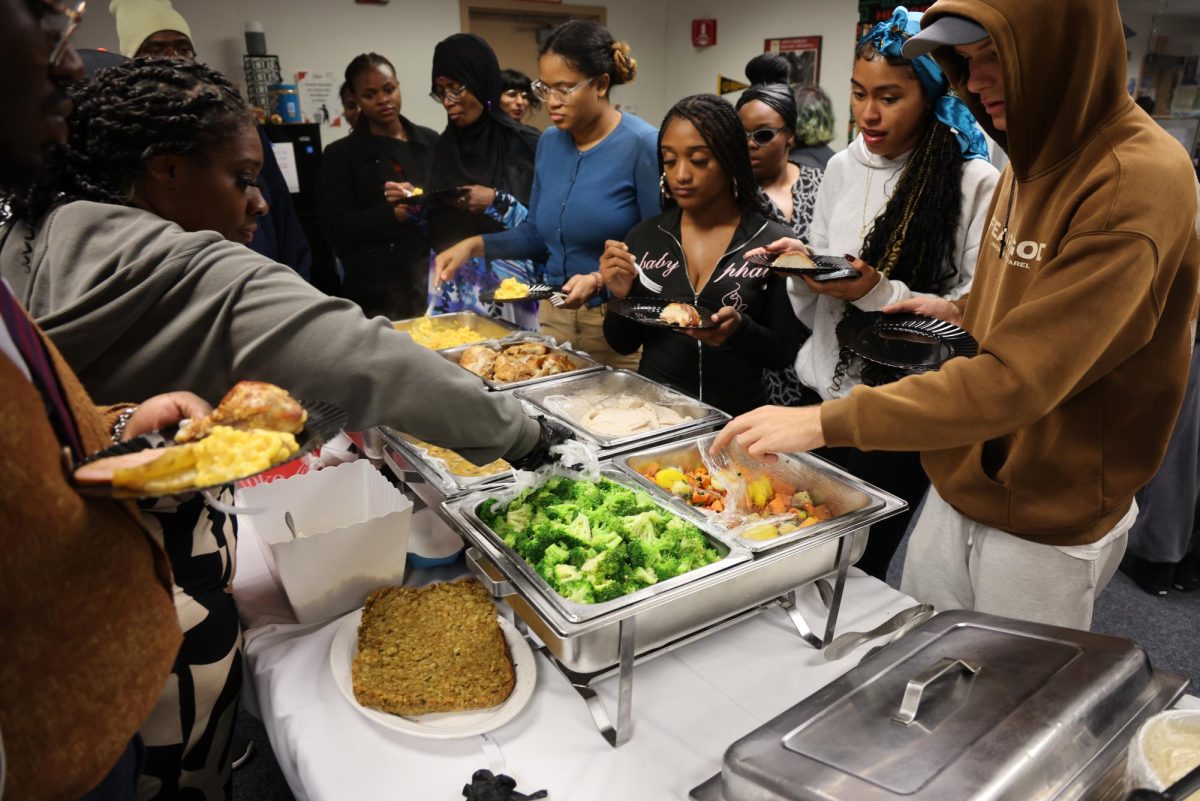
This year’s Friendsgiving doubled as a wellness event, centered on gratitude and emotional connection. After students served themselves roast beef, turkey, macaroni and cheese and mashed potatoes, they took turns expressing what they were thankful for.
Umoja’s embedded therapist and the student health center clinician, Staci Graham, also had attendees drawing what they were thankful for on a symbolic gratitude tree.
“Gratitude helps tap into the things that make Black people naturally resilient,” said Graham. “So much discussion around our wellness is deficit-based—what’s wrong. Gratitude shifts that. There is always something to be thankful for, no matter what.”
Graham emphasized that many barriers Black students face—stigma, lack of access, fears of discrimination—mirror broader inequities in the mental health system. Umoja’s embedded mental-health support, she said, aims to remedy that access gap.
“Historically, Black people haven’t had equitable access to mental health care,” said Graham. “Even when they do seek help, the way they’re received can be very different from their non-Black peers. That’s why a culturally grounded space matters. When students see someone who reflects their experiences, it normalizes and validates what they’re going through.”
For GJ Kelly, a first-year football player from Louisiana and Texas, that validation has been essential.
“I didn’t know a lot of people when I first got here,” said Kelly. “Besides football, I didn’t really have anyone. Coming to Umoja opened me up to more than just athletes. It helped me meet different people.”
Kelly said that Umoja has supported him academically and emotionally. Instead of isolating after long practices, he often ends up in the Umoja Center studying, relaxing, or simply being around others.
“It keeps me from just going home and sleeping. It reminds me that people care about me outside of football.”
While Kelly found community as an out-of-state athlete, Janae Hudson, a 36-year-old returning student in her first semester back to college in about a decade, came to Friendsgiving seeking something she struggled to find in Orange County. According to Hudson, Umoja quickly became an anchor for her on campus.
“I wanted to get invested in a Black community. Living in Orange County, we don’t see many of us around. It is necessary. I want to identify with people who feel close to my experience,” said Hudson. “It gives me a place to feel comfortable. Somewhere to communicate, hang out between classes, and study. I feel like I belong here more than anywhere else.”
According to The Mayo Clinic, the holidays are a time when people feel the loneliest and most self-isolated. Hudson said that the Friendsgiving event was a reminder of what she needed.
“Sometimes I feel alone. I don’t know many people yet, and I’m new to the city. Having a place where I feel supported and seen is very important for my educational journey,” said Hudson.
She has already taken advantage of Umoja’s counseling resources. They offer services like academic counseling, personal therapy, cultural and academic workshops, as well as porch talks, which are a safe place for students to build a sense of community with others while discussing topics in the Black/African American community.
“Meeting with counseling solidified why I’m here and what my purpose is,” said Hudson. It reassured me I’m on the right path.”
For Hudson, community also means shedding the pressure to “perform” or explain herself—something she often feels in other spaces.
“Here, I don’t have to walk on eggshells. I don’t have to be guarded. I can just be myself. ‘Naked,’ so to speak, that’s the best way I can explain it,” said Hudson.
In 2021, the American Council on Education collected information showing that out of 712,180 full-time faculty across the U.S., only about 6% were Black or African American, and out of 645,000 part-time faculty, about 9% were Black or African American. Seeing Black faculty and staff at the event further affirmed Hudson’s sense of possibility.
“It’s inspiring,” said Hudson. “It lets me know it’s not too late for me. If they can be in those positions, so can I. It’s a reflection—it gives me permission to believe I can do it.”
Umoja continues to track engagement through check-ins, institutional research, and follow-up with students who drift away. But for Salsberry and her team, the meaning of Friendsgiving is simpler: the spark of connection that students carry with them after they leave the room.
Within an institutional landscape where Black students often experience marginalization, Umoja provides a structured environment of community, cultural validation, and sustained support.
