
In this weekly opinion column, we’ll take a look at protest songs from the past that reflect the political themes of today.
There is growing sentiment among American musical artists to stand against ICE. While many tout their support on red carpets and galas, few utilize their medium to represent their respective movements.
Compared to artists of previous decades, there is a lack of notable protest works. This artform must be utilized, because there is nothing more defining than the song of the cause.
In 1941, a musician named Al Bowlly recorded “When That Man is Dead and Gone,” a song envisioning the time after Adolf Hitler’s death. Little did he know that this would be his final record. Two weeks later, he was killed by a Nazi parachute mine.
He had a promising career ahead of him and had gained some recognition from his many works. The most notable came long after his death from the film adaptation of “The Shining,” which used his song, “Midnight, the Stars and You.”
The core message of “When That Man is Dead and Gone” is that there is a specific evil man, Hitler, who makes life hell for all, but he will die eventually. Although he is not mentioned by name, Bowlly is descriptive of the man he sings about and calls him the devil in disguise:
“What a day to wake up on / What a way to greet the dawn / Some fine day the news’ll flash / Satan with a small moustache / Is asleep beneath the lawn / When that man is dead and gone.”
The song received very little attention until recently, when a local jazz band, Lizzy and The Triggermen, posted their cover of “When That Man is Dead and Gone” in 2017. It saw mild success. In the first weeks of January 2026, their live performance and video cover of the song received an explosive increase in popularity and gained over half a million views.
In more recent news, two American citizens were filmed as they were killed at the hands of Immigration and Customs Enforcement agents. The deaths of Renee Good and Alex Pretti come at a time when more information surrounding ICE misconduct is rising. For example, officers admitting to sexually abusing detainees or a surfaced video depicting a male ICE agent taking a person who is handcuffed into a porta-potty.
“Rape, murder, it’s just a shot away.” The Rolling Stones wrote these lyrics in the song Gimme Shelter in 1969, in an era known for its counterculture movement and the horrors of the Vietnam War.
If there had to be one song to define the generation that wanted to give peace a chance, this would be it. It tells the listener of the desperate search for sanctuary amid fire, flood, storm and war. They declared, in the absence of taking care of each other and the allowance of violence, war would come.
The song suggests that one pull of a trigger is all that’s needed to destroy the progress we have made. In the case of Good and Pretti, we did not just get one pull of a trigger; we received three and ten.
In a show of unison, vigils were held for the dead killed by ICE. The community mourns, but even in that moment of grief, another injury is made. According to Chad Knutson, who was watching a livestream of the vigil, he noticed an ICE agent took a flower from the memorial of Good and mockingly gave it to another officer, and together they laughed at the gesture. At another vigil, an officer was recorded kicking over a candle lit for Good.
With events such as these, it is not difficult to see why the nation reacts in the way it does. Many members of our community react with anger, grief and feel the need to do something about it.

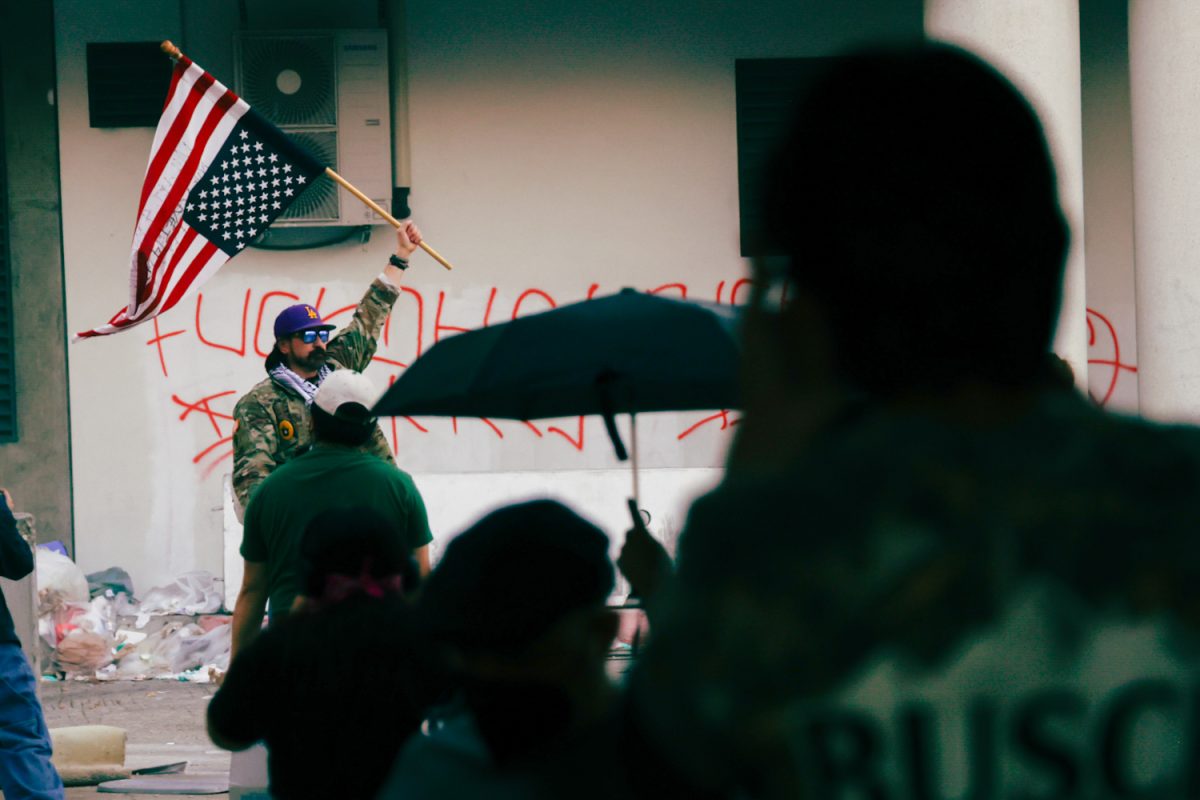
On Friday, there was a protest at the Metropolitan Detention Center in downtown Los Angeles. There was a moment when the police marched towards the protestors in full riot gear. As the protestors pushed away, a bus drove between the two groups, effectively shielding the protestors from the advancing police.
However, some of the demonstrators began to spray paint the bus. They were quickly chastised by fellow community members, as they did not want to provide ammunition to their detractors. This fear is not unprecedented, as only a few hours later, Fox News depicted coverage of the protest as violent agitators.
“The revolution will not be televised.” So said Gill Scott-Heron in 1971 with a poem turned song of the same name, with lyrics describing everything the revolution would not be.
The revolution, as he states, will not be entertainment used to pacify. It will not make you more comfortable. It will not show what good our Second Amendment right has done. What will be shown are the agitators and bad actors to push an agenda, not for our betterment:
“There will be no pictures of pigs shooting down brothers on the instant replay.”
He illustrates that, most importantly, change is not passive. If we are to see any real change, any real betterment, it must be done through active participation. Not only that, if it is to be done, it must be done immediately, while we still have a chance, because we do not know if we will ever see another opportunity:
“The revolution will not be televised / … /The revolution will be no re-run, brothers / The revolution will be live.”
Voices of the past echo the lyrics shouted by protesters in an uncertain era of American history. “We The People” hum as those in the streets sing the symphony in harmony against the brutal noise. Let the songs of those remind us that victory is a verse away and guide us to the crescendo of peace.